I recently wrote a couple of blog posts, the first on Movember, the second on being strict Paleo for a month; they both featured some statistics – weight (easy), body fat (so-so), visceral fat (?) and muscle mass (?). I’ve received a few questions on how I glean these readings, and how accurate actually are they. Well, hopefully this blog post will define the answers for you.
So, as you have probably guessed from the title, I use a pair of Tanita scales – well they are actually billed as ‘Body Composition Monitors’ but you get the idea. The exact model is the BC-587 and I have owned these for a couple of years now. I’ve had Tanita scales like this since 1998 and they seem pretty accurate; I’ve been recording my weight / fat since then and the figures are pretty stable.
There are a lot of readings that get spat out of the scales, some are pretty explanatory, others require some explaining:
- Total Weight in increments of 0.1kg
- Body Fat in increments of 0.1%
- Healthy Range Indicator
- Body Water Percentage
- Muscle Mass
- Physique Rating
- Bone Mass
- Basal Metabolic Rate (BMR)
- Metabolic Age—up to 50 years
- Visceral Fat Rating
The high-level overview of how these scales work, is below – this has been taken directly from the site so I do not claim to have written this myself:
All Tanita body composition monitors use advanced Bioelectric Impedance Analysis (BIA) technology. When you stand on a Tanita monitor, a very low, safe electrical signal is sent from four metal electrodes through your feet to your legs and abdomen.
The electrical signal passes quickly through water that is present in hydrated muscle tissue but meets resistance when it hits fat tissue. This resistance, known as impedance, is measured and input into scientifically validated Tanita equations to calculate body composition measurements. Depending on the monitor, body composition measurements are provided in under 20 seconds.
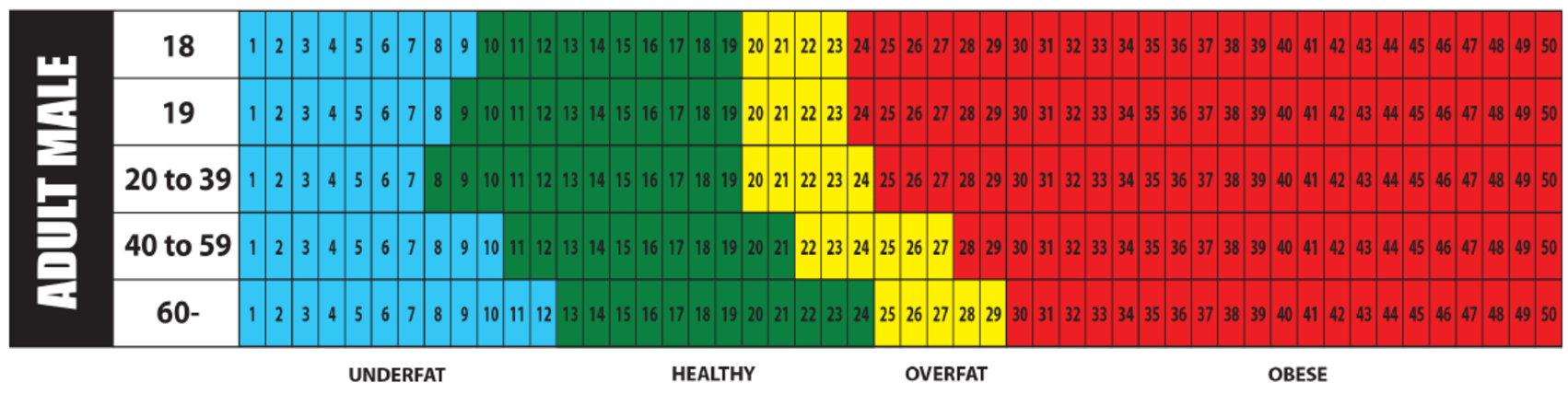
Body fat, this is pretty self explanatory and the below chart shows the four main ranges. My last reading was 8.7%, so this puts me at the lower end of healthy.
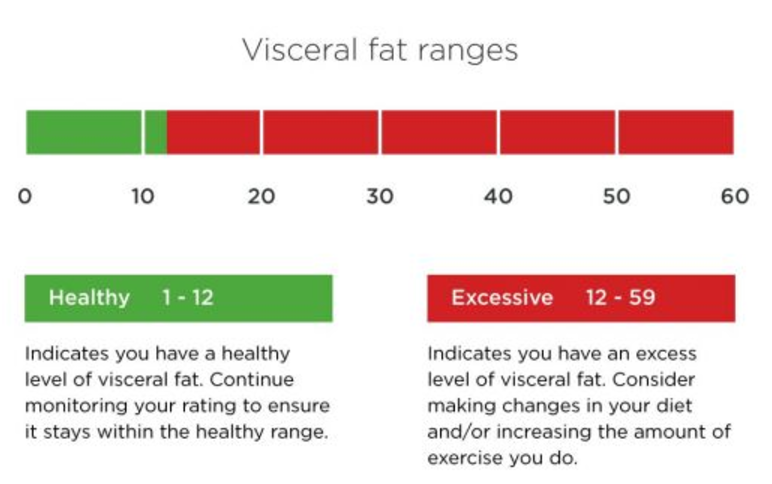
Visceral fat is very important to keep an eye on. This is a measurement of the fat inside of your chest cavity and abdominal area – the reading is on a scale of 1-59, the lower the better. My last reading was 2 and the chart is below:
The muscle mass reading is similar to the overall weight, the estimated weight of all skeletal and ‘normal’ muscles in your body. This is a good way to keep track on how effective your weight training is, your weight increasing will hopefully also show your muscle mass increasing with it.
The physique rating is, like visceral fat a Tanita scale and is on 1-9 based on the below:
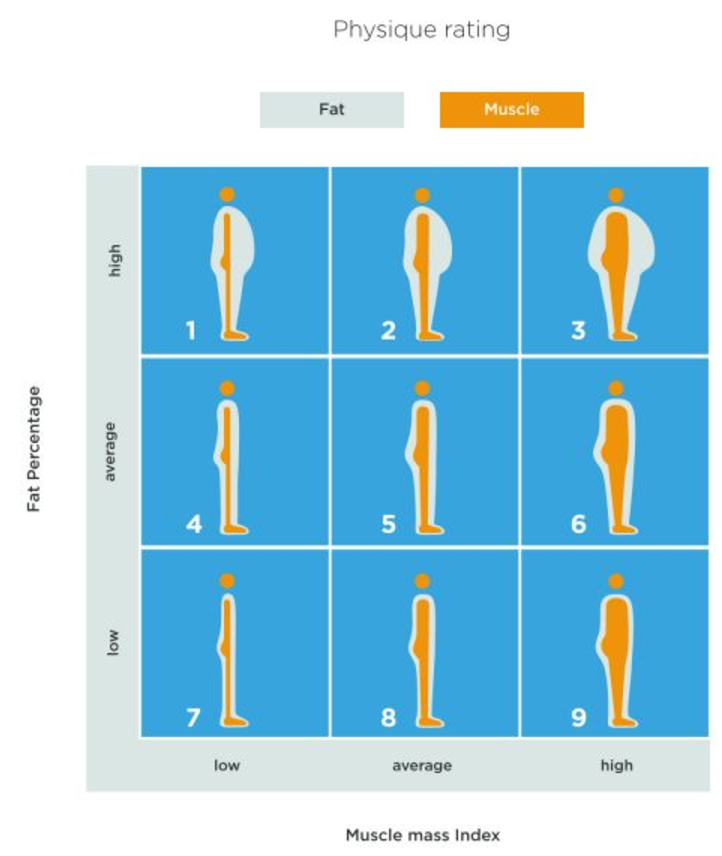
I’m a 4/5 usually, hoping to become an 8 or 9…
The bone mass is the predicted weight of bone mineral in your body, mine has been a steady 3.2/3.3 Kg since 1998 so that is pretty good. A sudden drop would be worth seeing a doctor for as it should remain pretty constant.
The last two are basal metabolic rate (BMR) and metabolic age. The premise behind this is that the BMR is the calories or kilojoules that your body requires for maintenance in a day, this is before any exercise etc, just to keep going. The more muscle you have, the more calories it takes to keep it going – another good reason to put on a couple of Kg of lean muscle. The metabolic age compares your BMR to an average for your age group.
This is calculated by comparing your basal metabolic rate (BMR) to the BMR average of your age group. If your metabolic age is higher than your actual age, it’s an indication that you need to improve your metabolic rate. Increased exercise will build healthy muscle tissue, which in turn will improve your metabolic age. My last metabolic age was ~20 (I’m 36).
Hopefully this is of use to someone and I would absolutely advise anyone really serious about their health to invest in some smart scales. I stand by the Tanita ones and would recommend them to anyone in a heartbeat.
Cheers,
Graham

 Mountainrescuer - the blog of Graham Brown
Great explanation, thank you. I have been using Tanita for many years, I currently use a Iron Man Inner Scan Dual. Recently I had a serious virus which precluded me from aerobic exercising to the level I was previously at. I have a small farm in Florida which requires a lot of work including some heavy lifting.
Not long after the virus (Coxsacki) my weight increased from 170lbs to 191Lbs. The Tanita scale is telling me that my fat content at 14% is the same for both weights, but my muscle weight has increased by 16lbs. Its possible given the amount of heavy lifting I do, however I am suspicious. Any comments would be appreciated
LikeLike
Hey Stewart, so sorry for the delay in getting back to you. My blog sort of got forgotten during the last few crazy years. Firstly, thanks for the kind words. Secondly, the stats seeming odd, could be correct or they could be due to your change in activity levels. The scales have two setings, athlete mode and normal – I find that if I am starting out after a period of not excersing my stats are regular, in that if I lose weight, lose far etc things are in a nice trend, then suddenly things ‘jump’ this is where you need to change the setting, over to athlete mode. I think it has a lot to do with the amount of water you hold. It has been a long time since I went through that phase, so can’t remember the specifics. IIRC the bone density was always a constant, then it would really deviate and that was the trigger to change – not perfect, but this is what I found over time. HTH, Graham.
LikeLike